Empowering CSOs: Bridging Social Impact and Financial Risk Through the Double Materiality Framework
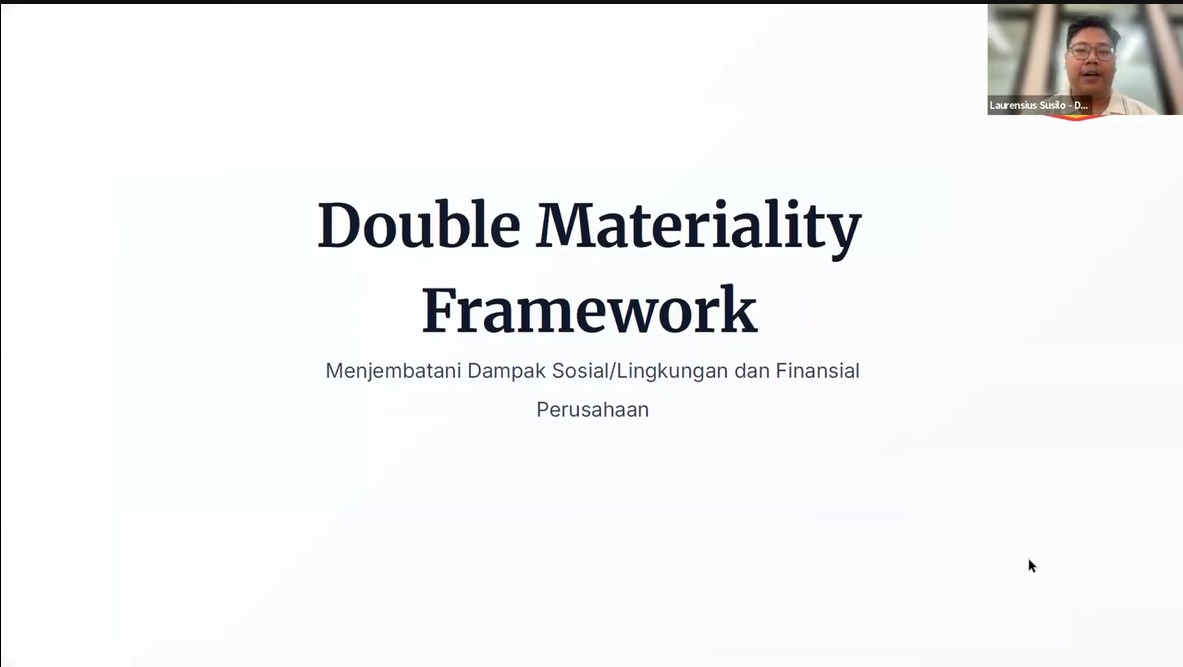
On June 17, 2026, the INTRA – ANGIN Advisory successfully hosted a pivotal seminar and workshop titled "Closing the Gap: From Field Evidence to Investor Engagement." The event featured Laurensius Susilo Yunior, a prominent researcher from the Djokosoetono Research Center at the Faculty of Law, Universitas Indonesia, as the primary resource person. With a deeply rooted focus on law, public policy, and human rights advocacy, Laurensius led an intensive capacity-building session aimed at upgrading Civil Society Organizations (CSOs) to master and apply the Double Materiality Framework in their report writing and field research. During the workshop, Laurensius presented a comprehensive guide based on his presentation, titled "Double Materiality Framework: Bridging Social/Environmental and Financial Impacts of Companies". He emphasized the extreme urgency of understanding this framework, noting that environmental or social issues can trigger both instant and long-term effects for businesses. If ignored, these effects create tangible financial disruptions that eventually harm a company's profitability and cash flow stability, while also obstructing access to capital and deterring new investors.
To provide a solid foundation for the participants, Laurensius outlined the historical evolution of corporate sustainability reporting. He explained that prior to 2015, sustainability standards stood separate, with social impact being regulated by GRI and financial aspects by SASB. The timeline progressed significantly with the 2015 Paris Agreement, which catalyzed global sustainability awareness, eventually leading the European Union to formulate the Corporate Sustainability Reporting Directive (CSRD) in 2022 and establish the European Sustainability Reporting Standards (ESRS) as a mandatory reporting system for companies in 2023.
The core of the workshop focused on the mechanics of Double Materiality, which seamlessly marries Impact Materiality and Financial Materiality. Impact Materiality utilizes an "inside-out" perspective, focusing strictly on how a company's internal operations directly impact the surrounding environment and its stakeholders. Financial Materiality, conversely, uses an "outside-in" approach, analyzing how external climate changes or social crises tangibly affect the company's financial position, performance, cash flows, and cost of capital. A major highlight of the session was Laurensius’s powerful assertion to the attendees: "Impact Materiality that is ignored will slowly become Financial Materiality". He illustrated this concept by explaining that dumping waste into a river might initially appear to be purely an environmental problem, but it will eventually transform into severe financial and legal sanctions for the corporation.
The primary objective of this upgrading session was to equip CSOs with the analytical tools to bridge their traditional focus—such as social impacts, environmental issues, and human rights violations—with the priorities of investors, who focus heavily on risk management, returns, cost efficiency, and governance. Laurensius explained that a Double Materiality Assessment (DMA) serves as the necessary bridge because both CSOs and investors are essentially looking at the exact same problems from different vantage points.
By mastering the DMA methodology, CSOs can utilize their research as a powerful "advocacy bullet". Laurensius detailed how NGOs can structure their reports to contain empirical findings, clearly identify violated national or international standards, project the potential financial impacts if these issues are left unaddressed, and provide concrete, actionable recommendations to investors. Furthermore, he stressed that CSOs must verify internal corporate policies by ensuring companies have a specific Code of Conduct, checking if grievance mechanisms align with UNGP Principle 31, and actively monitoring the realization of promised remediation mechanisms.
Laurensius also guided the participants through the detailed methodology of the framework, starting with comprehensive stakeholder mapping. This involves identifying both affected groups that face risks from business processes and supply chains, as well as influential groups like investors, government bodies, and academics. He introduced the 10 ESRS assessment indicators, categorized into Environmental (e.g., climate change, pollution, biodiversity, and circular economy), Social (e.g., own workforce, workers in the value chain, and affected communities), and Governance (e.g., business conduct) topics.
For a proper Impact Materiality assessment, analysts must evaluate potential and actual impacts based on scale, scope, irremediable character, and likelihood using a 1-5 scoring system. These findings are then plotted on an identification matrix to determine mitigation priority; issues positioned higher (severity) and further to the right (likelihood) demand the utmost attention and urgent action from the company.
Addressing the specific context in Indonesia, Laurensius highlighted significant regulatory gaps that CSOs must navigate. He noted that the Indonesian government is currently still in the drafting stage of a Presidential Regulation (Perpres) regarding Human Rights Due Diligence. Furthermore, while the Financial Services Authority (OJK) Regulation POJK 51/2017 currently mandates sustainability reports, it lacks detailed stipulations on the exact reporting standards that companies must use. Consequently, there is a notable practice gap, as the implementation of the Double Materiality Assessment methodology in Indonesian Sustainability Reports remains virtually nonexistent.
The INTRA – ANGIN Advisory event concluded with a strong call to action to realize a truly sustainable business ecosystem. By effectively utilizing the Double Materiality Framework taught by Laurensius, CSOs are now better equipped and positioned to transform raw field evidence into compelling financial data that drives responsible investor engagement and ensures long-term corporate accountability.